Common Sense by Joel Greenblatt
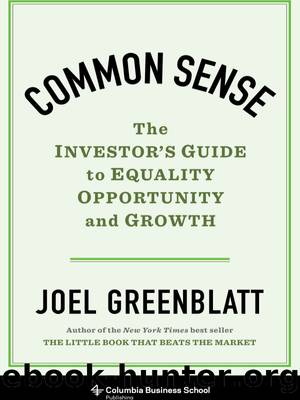
Author:Joel Greenblatt
Language: eng
Format: epub
Tags: BUS011000, Business & Economics/Business Writing, BUS019000, Business & Economics/Decision-Making & Problem Solving
Publisher: Columbia University Press
Published: 2020-08-09T00:00:00+00:00
Where did this King guy come from anyway?
Chapter 3
Technology, Globalization, and Disruption
When Thereâs No Time for Educationâ¦
I admit it. I spent four years in college as an accounting major. Not only does that sound boring, I still donât know what I did for four years. Revenues minus expenses equals net income. Assets minus liabilities equals net worth. Thatâs probably 80 percent of itâtakes less than two minutes with time for a doughnut.
Maybe I chose accounting because, growing up, my father would walk around the house sharing his pithy Brooklyn-born street wisdom. Stuff like, âFigures donât lie, but liars can figureâ and âTake two and hit to rightâ (though still not sure how not swinging at the first two pitches and then hitting to right field was supposed to help with my homework). But maybe it was because in seventh grade, I spotted Darrell Huffâs How to Lie with Statistics in the school library (good shot the librarian was also from Brooklyn), a copy of which I still keep on my desk. Whatever it was, I learned early that it was probably a good idea to figure out how numbers work (especially since 54.36 percent of statistics are just made up).
As it turns out, in the accounting world, one of the places the numbers get (slightly) more interesting is when people spend money on things that last a long time. Say you decide to buy a large machine for your business, and it costs a million dollars. You figure the machine should last about ten years. It doesnât seem fair to charge the whole million dollars to this yearâs expenses. Youâre planning on using the machine over the next ten years and youâll still have plenty of life left in the machine after the first year is over. So, what accountants often do is spread that million-dollar one-time expense equally over the ten years that the machine will be used. That way, each of the ten years you plan to use the machine will only get charged $100,000 in expenses. That annual $100,000 charge is called depreciation and itâs the way accountants try to match the cost of using the machine for one year with the amount of sales (or revenues) the business generates each year.
Recently, though, accounting has gotten even more exciting (if thatâs possible). The world of annual or monthly subscription services has made figuring things out a little more complicated. Letâs say a maker of computer software sells software that helps businesses keep track of their inventory. You run a small business and want to purchase the software. But instead of selling you the software, the software manufacturer charges you $1,000 per year to use it. The manufacturer figures that the average customer will last about 8 years. Why? Because once you choose a software system to store all of your inventory information, itâs probably expensive for you to switch to another software provider and retrain all of your employees to use the new system.
So, hereâs the exciting part.
Download
This site does not store any files on its server. We only index and link to content provided by other sites. Please contact the content providers to delete copyright contents if any and email us, we'll remove relevant links or contents immediately.
Rich Dad Poor Dad by Robert T. Kiyosaki(6633)
Pioneering Portfolio Management by David F. Swensen(6301)
How To Win Friends and Influence People by Dale Carnegie(4513)
The Money Culture by Michael Lewis(4207)
The Dhandho Investor by Mohnish Pabrai(3765)
The Wisdom of Finance by Mihir Desai(3748)
Liar's Poker by Michael Lewis(3450)
Fooled by Randomness: The Hidden Role of Chance in Life and in the Markets by Nassim Nicholas Taleb(3124)
The ONE Thing by Gary Keller(3071)
Mastering Bitcoin: Programming the Open Blockchain by Andreas M. Antonopoulos(3045)
The Intelligent Investor by Benjamin Graham Jason Zweig(3042)
The Psychology of Money by Morgan Housel(3037)
Rich Dad Poor Dad: What The Rich Teach Their Kids About Money - That The Poor And Middle Class Do Not! by Robert T. Kiyosaki(2958)
Investing For Dummies by Eric Tyson(2955)
How to Day Trade for a Living: Tools, Tactics, Money Management, Discipline and Trading Psychology by Andrew Aziz(2949)
How to Win Friends and Influence People by Dale Carnegie(2915)
Market Wizards by Jack D. Schwager(2701)
How to Pay Zero Taxes, 2018 by Jeff A. Schnepper(2655)
Zero Hour by Harry S. Dent Jr. & Andrew Pancholi(2649)
